
About Chandigarh Group of Colleges, Jhanjeri, Mohali, Punjab
CGC Jhanjeri, established in 2012, under the Chandigarh Educational Society stands as a beacon of academic excellence in India, holding the prestigious NAAC A+ accreditation. Renowned for its stellar research and teaching standards, the college boasts a highly skilled faculty and an innovative learning environment. CGC Jhanjeri and its affiliated institutions are administered and operated under the guidance of the Chandigarh Educational Society and promise to deliver quality higher education at affordable fees.

The college's dedication to academic excellence has earned it the esteemed NAAC A+ accreditation with a CGPA of 3.46/4.0, cementing its position as a leading institution in the country. CGC Jhanjeri is committed to academic excellence, affordability, and holistic student development, making it a preferred choice for students nationwide.
Mission
To make incessant endeavor to translate our vision into a reality & achieve the
following objectives:
- To create world-class facilities & ambience for advance level of teaching and practical training.
- To make students socially inclusive individuals with conscience, commitment & education.
- To continuously grow & become a fountainhead among institutes of Technical Higher Education in India.
- To strengthen industry-institute interface & promote entrepreneurial development activities.
- To continuously strive for research, development & innovation in all relevant fields, thereby providing the faculty & students the requisite platform to showcase their talent & win laurels.
- To collaborate with leading universities of the world with a view to provide students with opportunities for higher studies & seek placement avenues abroad.
- To be at the apex of placement charts across India, ensuring every CGC'ian gets the best of opportunities
Vision
To emerge as the most preferred educational group with global recognition, developing competent and socially sensitive leaders committed to excellence.

About Chandigarh Law College,
Jhanjeri, Mohali, Punjab
About Chandigarh law College:Established in 2021, Chandigarh Law College, Jhanjeri has quickly become a prominent institution for legal education. Offering a 3-year LLB program along with various 5-year integrated programs such as BA LLB, BCom LLB, and BBA LLB, the college caters to diverse legal interests. Despite its recent establishment, Chandigarh Law College has made a notable impact by blending academic rigor with practical training to develop future legal professionals
Chandigarh Law College takes pride in its accomplished faculty, comprising experienced legal scholars and practitioners who provide a rigorous academic environment and real-world insights. The curriculum is thoughtfully structured to cover both substantive and procedural law while emphasizing experiential learning. The institution is equipped with state-of-the-art infrastructure, including well-stocked libraries, digital resources, and a moot court to facilitate practical training.
Chandigarh Law College places a high value on real-world experience, offering students internships and placements with renowned law firms and corporate entities. Co-curricular activities, such as moot court competitions, workshops, and seminars, further enhance advocacy and communication skills of the students. The commitment of students to high-quality education is reflected in its accreditations and affiliations. Testimonials from students emphasize the enriching learning experience and the role of the college in cultivating future legal leaders.
International Moot Competition Objectives
A moot court is a replica of real court proceedings. The purpose of moot court competitions is to make students aware about the court proceedings related to disputes between parties. This competition is often organised in law schools for students who wish to pursue their careers as litigators and Arbitrators. This practice develops of legal skills, research acumen and speaking skills. The process of mooting is not the same as public speaking or debating, moot courts are primary interactive in nature and there is cross-questioning.
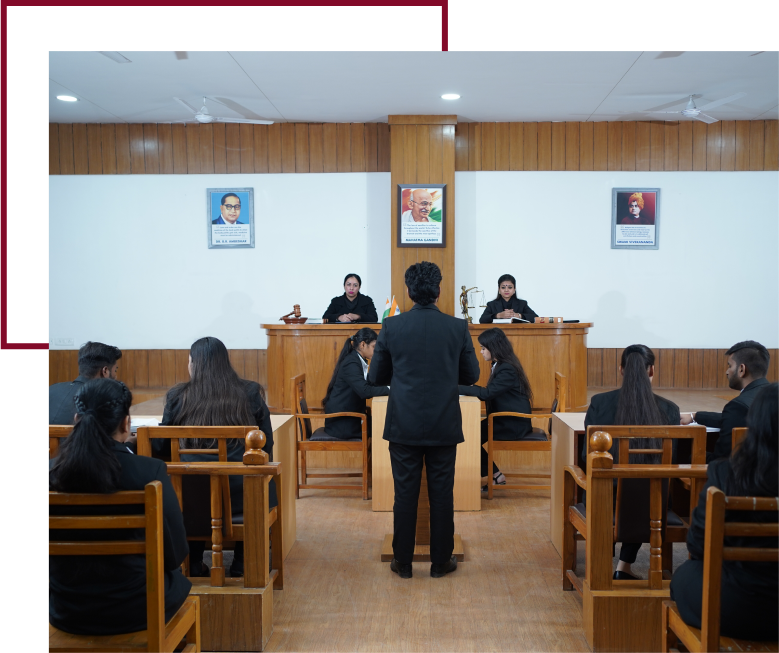
All students currently enrolled in three year or five-year law courses are eligible to participate in the competition. There will be maximum 32 teams selected for this competition. First come First Served.

The competition is to be held at Block 4, Seminar HallChandigarh Law College, Jhanjeri, Mohali.
The participants shall adhere to proper dress code while presenting in the court room during the competition. The dress code is white shirt and black trouser/suit and black blazer, black shoes & White Socks.
The official language for the competition shall be English only.
- Each team shall consist of a minimum of two (2) members and maximum of three (3) Members. Teams comprising of two members shall only have two (2) speakers and teams comprising of three members shall have two (2) speakers one (1) researcher.
- Each team should identify such speakers and researcher at the time of registration. The researcher is not permitted to speak except under special circumstances and only with express permission of the judges.
- There shall be no circumstance whatsoever that a team consisting of more than members be allowed to participate. No observer/additional member can be part of a team in any capacity.
- There shall be no substitution of any team member after a team has submitted its
Registration Form, except with the permission of the Organizers.
Structure of the Competition
- The Moot court Competition shall comprise of following rounds:
- Preliminary Rounds
- Quarterfinal Rounds
- Semifinals Rounds
- Final Round
- After the orientation of the teams, the draw of lots shall take place and the team has to argue on behalf of both sides, the Prosecutor/Applicant/Petitioner and the Defendant/Respondent in the preliminary rounds.
- The top 8 teams, based on the cumulative score of memorials and preliminary rounds, shall qualify for the quarterfinals. Further, the top 4 teams, based on the results of the quarterfinal rounds, shall qualify for the semi-final rounds. Finally, the top 2 teams will be selected for the final round.
- In case of a tie, the highest memorial marks will be taken into consideration to decide the winner.
Draw of Lots
Before the Preliminary (on 8th November 2024), for the Quarterfinal, Semifinal, and Final rounds, the draw of lots shall be done to determine the side on which the Team shall be arguing. The Teams shall be mailed the fixtures for each round. Further, the Teams shall also be mailed the soft copy of their opponent’s Written Submission prior to the oral rounds.
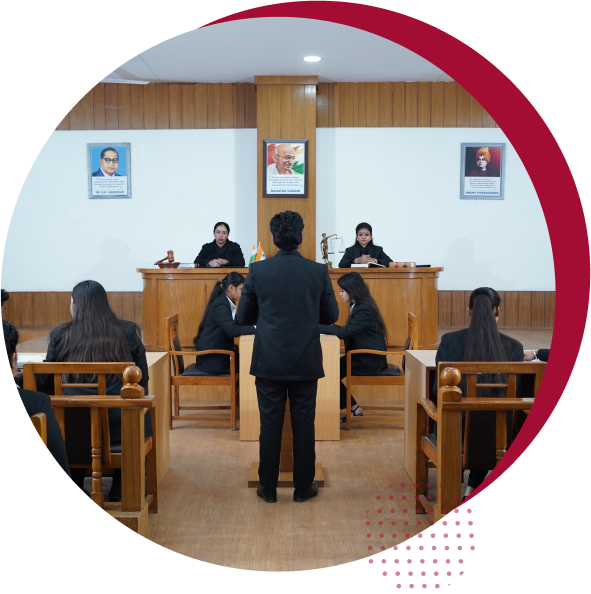
- As specified hereinabove, each team shall have two speakers who shall further divide the oral submissions between themselves.
- At no point of time during the Competition, any speaker shall reveal their identity.
- Any compilation or detailed pleadings will not be entertained. The participants are requested to bring with them the authorities/case laws on which they want to rely during the arguments.
- At the commencement of each round of Oral Submissions, each team shall notify to the Court Officer the division of time between the two speakers.
- Further, each team must notify to the Court Officer the amount of time that the team wants to reserve for their rejoinder /sur-rejoinder. A maximum of five (5) minutes may be reserved for the rejoinder/ sur-rejoinder.
- Only one speaker from each team shall be permitted to rejoinder / sur-rejoinder. The sur-rejoinder shall be limited to the rebuttals made by the opponent team. Five (5) minutes and Two (2) minutes before the completion of the allocated time for each speaker, there will be a warning bell, and at the completion of the allocated time for each speaker, there will be a final bell.
- In case a speaker continues to speak after the completion of his/her specified time, the additional time which he/she consumes will attract negative marking at the discretion of the judges. The judges shall have all the rights to grant opportunity to give rejoinder or surrejoinder and to allocate additional time.
- During the course of oral submissions, the participants cannot submit to the court any material containing pictorial representation whatsoever. Further, the participants are not be permitted to make any audio/visual representation nor allowed to use any online search engines during their submissions.
- If at any instance a submission is made with any material in violation of rules and if any picture, sketches, photos, cartoons, caricatures, audio film, video film, projector-slide or a computer-generated image is used or submitted or presented to the court, the teams shall be subject to disqualification.
In the Preliminary round, each team shall be given 20 minutes to present their oral arguments. The evaluation criteria shall be as follows:
| Particulars | Marks |
|---|---|
| Written Memorial | 30 |
| Oral Arguments | 40 |
| Time Adherence | 15 |
| Overall Performance | 15 |
| Total | 100 |
The teams selected out of preliminary round shall reach to the semi-finals, the side of the team shall be decided by way of draw of lots. Each team shall be allotted 30 minutes to present their oral arguments. The timing can be divided between both the speakers according to the wish of the team subject to the maximum of 17 minutes and minimum to the 13 minutes per speaker. A maximum of five minutes can be reserved per team for rebuttal and sub-rebuttal which shall be at the discretion of the judges and shall be exclusive of the above time limits. Evaluation in the semi-final round shall be done on the following basis:
| Particulars | Marks |
|---|---|
| Application of Law | 25 |
| Advocacy and Presentation | 20 |
| Answer to Court Question | 20 |
| Interpretation and Use of Facts | 15 |
| Time Adherence | 10 |
| Total | 100 |
In the final round, the win-loss shall be decided based on the aggregate score. No memorial score will be added in the finals. Each team will be allotted a total of 40 minutes to present their oral arguments. The timing can be divided between both the speakers according to the wishes of the team subject to a maximum of 25 minutes and minimum of 15minutes per speaker. The time division has to be informed to the court manager/clerk before the beginning of the oral arguments. Maximum of 5 minutes may be reserved for rebuttal or sub-rebuttal which shall be given at the discretion of the judges which shall be exclusive of the above time limits.
- Each team is required to prepare a memorial for both, the petitioner and the respondent. The memorial must be submitted in pdf format, font size 12 Times New Roman style along with footnotes.
- Each page must have a margin of at least 1.25 cm on every side of the text.
- Memorials must be continuously page numbered, excluding the front cover.
- Spacing the text of the memorial must be 1.5 spaced and footnotes must be single spaced.
- Headings and Sub-headings of more than one line in length must be single spaced.
- The front cover must contain the following information:
- The Team Code
- Title of the competition
- Title of the case
- The colour for cover page for petitioner is blue and for respondent is red.
- The memorial should not include:
- The names of team members
- Each memorial should not exceed 25 pages in which the advanced arguments should not exceed more than 15 pages.
The evaluation of the final shall be done in the following manner:
| Particulars | Marks |
|---|---|
| Application of Law | 20 |
| Advocacy and Presentation | 15 |
| Court Etiquettes | 10 |
| Answer to Court Question | 15 |
| Interpretation and Use of facts | 10 |
| Research Relevant to the case | 10 |
| Time Adherence | 10 |
| Overall Performance | 10 |
| Total | 100 |
The rules of the Moot Court Competition are to be strictly adhered and any deviation therefrom would attract disqualification, the decision regarding which shall be taken by CLC.
- The Competition will be conducted within the university campus.
- The link for the Draw of lots for the preliminary Rounds shall be provided prior to the date specified above for the draw of lots.
- The organizers shall have the rights reserved over all the submitted memorials and compendium and the organizers are free to use or dispose of them off in the manner they deem fit.
- There shall be a team representative/volunteer allotted to each team for their assistance.
- All the teams shall adhere to the dress code mentioned above.
- Non appearance with proper dress code shall attract a negative marking at the discretion of the judges
| S.NO | AWARDS | PRIZES |
|---|---|---|
| 1 | Winner Team | INR 10,000 |
| 2 | Runner- Up Team | INR 5000 |
| 3 | Best Speaker | INR 3000 |
| 4 | Best Memorial | INR 2000 |
| 5 | Best Researcher | INR 2000 |
Certificates of participation shall be given to all the participants.
- Fee: Rs. 3000/- team
- Account No. : SBI A/C 42591429590
- IFSC Code: SBIN0017008
- Branch: SBI Jhanjeri
Moot Court Event Details
| DATE | EVENT |
|---|---|
| September 2, 2024(Monday) | Release of Moot Court Draft and Proposition |
| October 25, 2024(Friday) | Last Date to register |
| November 4, 2024(Monday) | Allotment of Team Codes |
| November 4, 2024(Monday) | Last Date for Submission of Memorial |
| November 8, 2024(Friday) | Researcher’s Test |
| November 8, 2024(Friday) | Preliminary Round, Quarter Final |
| November 9, 2024(Saturday) | Semi Final , Final Round |
Miscellaneous
Strict action shall be taken if found scouting through a team member or otherwise or through any other unfair means.
- All participants are expected to maintain proper decorum in the Court during the Competition and are expected to conduct themselves in a manner befitting the legal profession.
- The Organizers reserve the right to take appropriate action for any unethical, unprofessional, and immoral conduct.
- The Organizer's decision as regards the interpretation of rules or any other matter related to the competition will be final and binding.
- If there is any situation that is not contemplated in the rules, the Organizer's decision on the same shall be final and binding.
- The Organizers reserve the right to vary, alter, modify, or repeal any of the above rules if so required and as they deem appropriate.
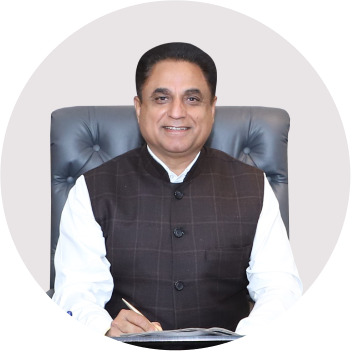
S. Rashpal Singh Dhaliwal
(Chairman, CGC)

Mr. Arsh Dhaliwal
(Managing Director, CGC)
All students currently enrolled in three year or five-year law courses are eligible to participate in the competition. There will be maximum 32 teams selected for this competition. First come First Served.
All students currently enrolled in three year or five-year law courses are eligible to participate in the competition. There will be maximum 32 teams selected for this competition. First come First Served.
All students currently enrolled in three year or five-year law courses are eligible to participate in the competition. There will be maximum 32 teams selected for this competition. First come First Served.
All students currently enrolled in three year or five-year law courses are eligible to participate in the competition. There will be maximum 32 teams selected for this competition. First come First Served.
All students currently enrolled in three year or five-year law courses are eligible to participate in the competition. There will be maximum 32 teams selected for this competition. First come First Served.
All students currently enrolled in three year or five-year law courses are eligible to participate in the competition. There will be maximum 32 teams selected for this competition. First come First Served.
Moot Proposition
With the enactment of new criminal law passed in July 2013, present case came into light. A 24-years old man allegedly strangled his live-in partner with a mobile phone cable and dumped her body in a refrigerator at a dhaba on the outskirts of Mitra village in west Big City. Reason of the murder was that she wanted him to perform his promise to marry her. There was no prior missing report or any other complaint filed by the family of Minni Yadav. The Girl’s father stated that the same day, call was made by her to him. She seemed sad about the fact that Sohal was not fulfilling his promise to marry with her Police said one of their officers who stayed in the village received information that the woman could not be contacted by her family. A tip off was then received that a man had killed his girlfriend and got married the next day. Sohal was arrested on Ist of July,2013 at 5;30 pm in the evening by a team of Police from sakhna village crossing in Big City . "He had strangled her with the data cable of his mobile phone in his white Verna car on the night of June 30. He then drove with the body to his dhaba located on a plot on the outskirts of village Mitra and dumped it in the refrigerator there. After the murder he married another woman on next day,"
Minni mobile phone was found in Sohal possession. Police said that mobile tower location of accused also found near the dhabha. Police said Minni got to know that Sohal engagement had been fixed. His wedding was on the following day. She kept pressuring him to call off the wedding. Around 9p.m on 30 June, Sohal reached Bindapur and the couple then left home in his car. Investigating officials stated the two reached Roman Gate area and had heated arguments for “almost an hour while seated inside the car.” Out of Sudden rage and infuriation, Sohal strangled herwith the mobile cable. He “panicked” and roamed the area for a few hours as he did not know what to do and carry the body in his car and reached at his dhabha. On reaching the dhaba, Sohal stuffed her body in blue-coloured single-door fridge and closed it using cable wires. "Since the preceding day, he had his wedding, the dhaba remained closed for the next couple of days,". Sohal, a resident of Mitraon village told the police that after schooling, he prepared for SSC exams at a coaching center in Uttam Nagar in January 2010.Minni, a resident of Diwan Nagar, was preparing for her medical entrance and was enrolled at another institute in Ram Nagar. The two would travel in the same bus and their friendship blossomed from there. Soon the two fell in love. In February 2010 Sahil took admission at a college in Greater Noida and Minni followed suit, enrolling in the BA (English Honors) course. Thereafter, in 2013 the two started living together at Greater Noida in a rented house. They travel together to several places. They returned to their respective houses and started living together in a rented house in Krishna area .Sohal did not inform his family members about his relationship. Later his family pressured him to get married and fixed his wedding.
Police said they recovered the body of the woman from the fridge and the data cable from his car. "A case of murder and destruction of evidence has been registered on the date of 4th July ,2013 at Baba Haridas Nagar police station. The police stated that the crime came to light four days later. Investigations into the murder also revealed that hours after allegedly killing her, Sohal deleted all the data from both his and the victim’s cell phones. He knew the phone chats could be used as evidence by the police, the senior officer said, adding that Sohal also kept her cell phone hidden. In the wedding photographs analysis by the police, Sohal didn’t look anxious. “He participated and danced with his family members. All this while, he didn’t look anxious,” the officer said, adding that even the police analyzed the wedding videos.
The Investing Agency said they have found traces of conversations being deleted from the victim’s cell phone in an attempt to mislead the police. “Possibly, the conversations had details of instances when the duo were quarreling over different issues. The accused was aware that phone conversations could be used as evidence against him. The Investigating Agency sent her mobile phone that was recovered from his possession to the Forensic Science Laboratory for further analysis and to retrieve previous conversations. The complete chat couldn’t be retrieved. Another officer investigating the case said Sohal was interrogated thoroughly. To corroborate his version of the crime, he has been taken to each location where he revealed during the interrogation to recreate the scene of crime, the officer said. According to DCP (crime) Ramesh Kumar, during the five-day police custody, the accused is asked to identify the routes he took on the day of the incident. The DCP added that Sohal confessed the crime. In the last few pages of personal diary she wrote about her sadness and depression because Sohal was not able to convince his parents for their relationship and wedding.
The police have invoked the Sections of murder, disappearance of evidence, intentionally omitting information regarding an offence, harbouring offender, criminal conspiracy and common intention.
The P.W 1 Dr. Bhikhubhai, in his evidence Exh.13 has deposed that 5 th July 2013, he was on duty at the Disha Government Hospital as a Medical Officer. At that point of time, a dead body of a lady was brought for postmortem by the Police Sub-Inspector of Police Station. He has deposed that the postmortem of the dead body of the deceased was performed on July 5, 2013 at around 11.45 hours and was completed at 13.30 hours.
Post-mortem report stated about the ligature mark is transverse, not completely encircling the neck and crossing the mid line on the thyroid cartilage. The base of ligature mark is soft and reddish in colour starting right lateral aspect of neck 7 cms away from midline, come to midline on the thyroid cartilage to left lateral aspect of neck and sight upwards size 14 x 1cms and not marked by deep.
Fracture of thyroid cartilage. No bony injury of skull bones, but fracture of thyroid cartilage of both superior horns.
As per statement recorded by Judicial Magistrate, Minni Yadav’s sister and her friend, who were the last persons to see Yadav alive and leaving the rented flat with Sohal. But both turned hostile.
Defence version was that he and Minni were simple friends. On that very day he was not with her. He doesn’t know she have committed suicide or murdered by any other person. He also produced the rent agreement copy of the Landlord of Krishna Enclave which shows the name of only Minni as tenant.
Trial Court awarded death sentence for offenses of murder along with other offenses on ground of electronic, medical, Statement of father and statement recorded by Judicial Magistrate and other evidences. High Court converted death sentence into life imprisonment. Accused filed SLP in Supreme Court for acquittal as well as challenge the Constitutionality of new laws. He also argued that trial is vitiated as conducted according to new laws. On the other hand deceased parents ask for the death sentence, for such well planned heinous crime. On present day appeal is being heard on following issues with additional issues, as per law, framed by teams.
1.Whether SLP is maintainable?
2.Whether the accused committed murder of the deceased?
3.Whether new laws have procedural retrospective effect?
4.Whether new criminal laws are constitutionally valid?
5.Whether accused must be awarded death punishment or other punishment?